

Our Swift Story so Far
- Cheryl Poole
- Aug 4, 2025
- 5 min read

In July 2022, we hosted a Biodiversity Open night, as per a previous blog. We had several different groups here setting up stands, including Wexford Bat Group, Wexford Naturalist Field Club, Dungarvan EIP, Teagasc, All Ireland Pollinator Plan and Wexford Barn Owl group. We got talking to Mark Stanley from the Wexford Barn Owl group. He ended up doing some ringing of swallows, and kingfishers here, as well as putting up a couple of barn owl boxes. As we got to know him, Alan mentioned in conversation that he had seen swifts in the valley a couple of times. We were wondering if there was anything that we could do for them.
Mark set about his mission then, and before we knew it he had been in touch with Dr James O’Neill who had successfully developed a couple of swift colonies in Ireland. We also went with Mark to see the swift boxes in Johnstown Castle. We came up with a plan for a swift box, and made six of them and installed them in the gable of one of our sheds. The new nest boxes looked out over the valley that we had seen them in. We also played a lure, which is a recording of swift calls, the idea being that they think there may a colony there and are curious, so they come for a look. We got them installed in April 2023.
Swifts winter in sub-Saharan Africa and travel north to breed. They typically arrive in Ireland in early May and are gone again in late August. A really fascinating thing about swifts is that from when they fledge until when they decide to breed which could be 2 – 3 years later, they never ever land. So they eat, drink and sleep on the wing and only ever experience wide open sky. Another fact is that they are the fastest bird in the world in flight. Every time I mention this fact my young experts remind me that falcon reaches higher speeds when diving.
If you put those facts together it is simply incredible to think that all of a sudden an instinct drives them to try and find a little crevice under an eave of a building, or something similar, and try to get into it! Usually they spend the first summer that they come home trying to perfect that art. These swifts are nicknamed bangers, a name derived from the way they bang up against potentially suitable holes to test out whether they are inhabited, as much as developing their approach skills. We were delighted to see some bangers investigating our nest boxes during the summer of 2023.
Typically a swift will find themselves a nest in the first summer they return, then the second summer they will make the nest comfortable, and try and find a partner. We were very excited to see would any of our swifts return and do this in summer 2024. James was updating some nest box cameras and so we got his old ones and set them up in the boxes. These were wired cameras so we had them hooked into an old TV in the shed, and it became almost an obsession to pop out and see were there any birds in the boxes! During the quiet seasons, we also made 6 more next boxes. We modified their design a bit so as to have a lower on the impact the face of the shed. We are conscious of trying to make these nest boxes as replicable as possible. So we now had 12 boxes, but only 6 cameras. We applied for a NPWS small recorders grant to upgrade but were unsuccessful. Still, we were lucky to spot a couple of nest boxes starting to be inhabited, and joy of joys, we had two swift pairs establish themselves.

That brings us to this year, 2025. Coming into the spring with high hopes and the accompanying nerves! We bought ourselves two new WIFI cameras and put them into the two boxes where the pairs had been spotted.

There was great excitement when our first swift returned on the 30th April. This is very early for swifts and was probably due to the favourable weather in the spring. Its partner arrived on 7th May. These were our box 12 pair back together again!

Our box 7 pair arrived on the 11th and 14th of May. We had the great joy of watching them bringing in nest material and zooming around in the sky together. Then the excitement of seeing eggs appearing. Box 7 ended up with 3 eggs and box 12 with 2 eggs. They were laid a couple of days apart, starting on 20th May.
Our eggs starting to hatch on the 10th June in box 12 and 13th June in box 7. Again, a new hatchling every two days.
Our first generation of Ballyowen born swifts! It was quite emotional to see them grow big and then to fledge.
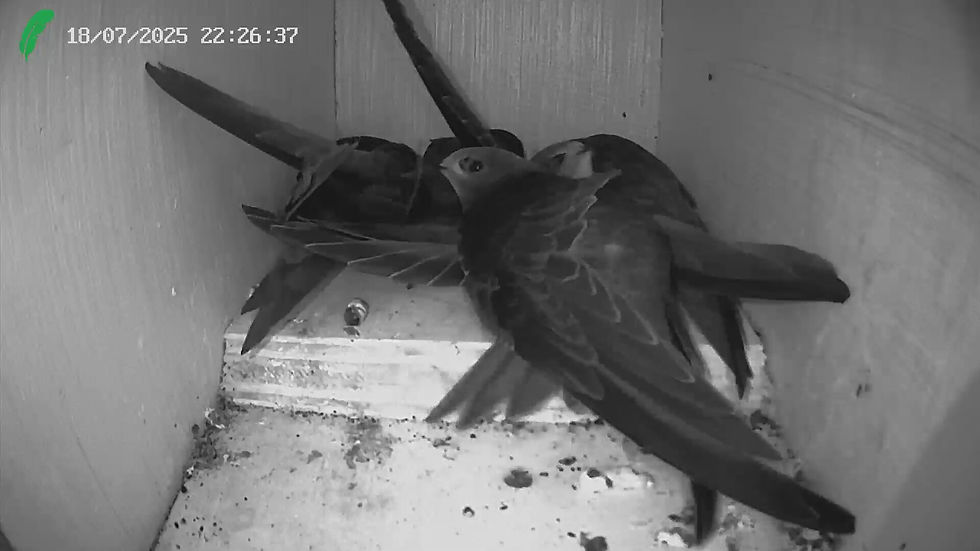
Dr James O’Neill and a couple of colleagues managed to get the swift chicks ringed on the 4th July. We will be able to find out if they are caught anywhere else.

As I mentioned before, from when they fledge to when they come back to look for a nest site, they never land, so the moment our little fledglings took flight out of the nest box, they were gone. They, most likely, immediately start to head south. They are independent from the word go. They learn to catch insects themselves. It is likely that the chicks and parents will never see each other again. The little fledglings don’t seem to imprint on where they were born. There is only a very small chance that they will themselves return here to breed.
Their parents return to the nest with food. Find the nest empty, eat the food themselves, and then sleep! I think a lot of human parents can understand that! The parents can stay around for a day or two, and then they too will head off south. Once the adults have claimed a nest site they are very loyal to it. So we will (barring anything unfortunate) see these parents back here again around next May.
Travel safe, our Ballyowen swifts! As of now at the start of August we still have a few bangers around, a week or so ago we regularly saw 7 or 8, in the last few days, we’ve only seen four. But this is a very hopeful sign for an increase in our new colony next year.


Comments